

REAL STORIES
Testimonials
Below read more about the personal stories of people who have found success, achieved their goals, and realized independence. We invite you to share these stories with your friends and family.
If you have any suggestions, or would like to be featured, please send an email to: info@rochesterrehab.org with Testimonial in the subject line.

LINDA ROLLINS
How OneSource Solutions helped one woman find renewed confidence
Linda Rollins, who was badly burned in a house fire several years ago, says she feels blessed these days. She has a job, her driver's license, and a renewed self-confidence, thanks to two programs of Rochester Rehabilitation: OneSource Solutions and DriveOn. OneSource Solutions employs people with disabilities in a variety of jobs including janitorial services, packaging and fulfillment, and document imaging. DriveOn helps people with disabilities drive safely and with confidence. "I thought I couldn't do a lot of things because of the accident, but I've built my self-esteem and overcome a lot of my fears," said Linda.
Severe burns and a brain injury from a house fire that also claimed the life of her father have left an indelible mark on Linda. During her recovery she endured months of skin grafts, hand surgeries, and therapy to walk and talk again. Consumed by pain, grief, guilt, and anger, she turned to drugs and alcohol. For years she struggled to cope, but eventually sought help from various agencies, support groups, family, and friends. Collectively, they helped her to overcome her addictions. But it was still difficult for her to be seen in public, let alone interview for a job. In September 2006, Linda interviewed for a custodian opening at OneSource Solutions Janitorial Services group and was hired to work with an evening cleaning crew at Monroe Development Center.
The job was demanding both physically and mentally. Linda needed to learn how to use her constricted hands to open garbage bag liners, clean restrooms, and mop floors. With help from her supervisor and job coach, and the support of her co-workers, she rose to the challenge and exceeded expectations.
Encouraged by her job success, Linda wanted to drive again. At Rochester Rehabilitation's DriveOn program she reconnected with her former occupational therapist provider, Midge Kogler. "One thing Linda said that I'll never forget," said Midge, Manager of DriveOn, "'you were never afraid to touch me.'"
Midge saw in Linda the desire and potential to drive. With driver specialist Don Palmere's instruction and patience, Linda earned her license last year. "I thought I couldn't do a lot of things because of the accident," said Linda. "I've built my self-esteem and overcome a lot of my fears." Because of her positive attitude and accomplishments, Linda won the 2008 William B. Joslin Outstanding Performance Award by New York State Industries for the Disabled (NYSID). She was chosen from among 50 individuals with disabilities who were honored through NYSID's annual recognition program.
To learn more about OneSource Solutions, please call Greg Wolfe at 585.473.2052 or email him at gwolfe@rochesterrehab.org.
To learn more about DriveOn, please call Nancy Steinkamp at 585.271.1894 ext. 1674 or email her at nsteinkamp@rochesterrehab.org.
Anthony DiPonzio
How DriveOn helped Officer Anthony DiPonzio
Officer Anthony DiPonzio went from ICU to independence with help from Rochester Rehabilitation’s DriveOn program.
Anthony DiPonzio serves and protects us all as a Rochester Police officer. His life, however, changed on January 31, 2009 when he was shot in the head while on duty. Doctors weren’t sure he’d pull through the delicate brain surgery, but he beat the odds and survived.
About 10 to 12 percent of people with traumatic brain injuries like Anthony’s survive and, if they do, less than half lead functional lives. Despite his injury, Anthony was able to maintain his intellectual capabilities, talk, and eventually walk unassisted. It was a tremendous recovery, but not an easy one for the then 23 year-old young man.
Would Officer Anthony DiPonzio ever be able to drive again?
Three years after the shooting, a white scar snakes through Anthony’s dark, clipped hair from the back of his skull to the right side of his forehead. He walks with a pronounced limp, has little functionality in his left arm, and lives with some vision loss. He’s also come further than most survivors of a gunshot wound to the brain.
“Anthony is a truly wonderful, remarkable individual,” says DriveOn specialist Pam Gabryel, who evaluated Anthony for driving. “He knew from the minute we started talking that he wanted to get back to work as a member of the Rochester Police Department and that he needed his driver’s license to achieve his primary goal.”
“My recovery wasn’t easy, but I kept at it,” says Anthony, who endured lengthy and grueling physical rehabilitation to regain his strength. “My goal was to drive on my own and get back to work. I realized how much I took for granted – something as simple as driving through the parking lot at work. If it wasn’t for Rochester Rehabilitation’s DriveOn program, I wouldn’t have been able to drive on my own and get back to work. Driving is a freedom that I’m thankful for.”
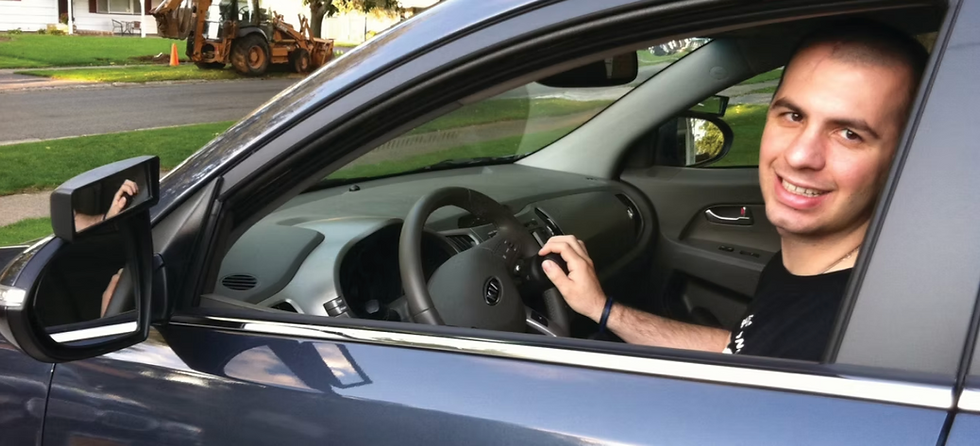
To assist his ability to drive safely, Anthony applies strategies he learned from his DriveOn training that help him process traffic and navigate roadway conditions. He also uses adaptive equipment such as a spinner knob with right hand controls and additional side view mirrors. Anthony’s determination and tenacity helped him get behind a new set of wheels, and in 2011 he was finally able to drive to work again.
Driving is the key to independence, employment, and mobility. As Anthony DiPonzio has shown the Rochester community, anything is possible as long as you set a goal, have faith, listen to the people who are there to help you, and work hard. “You can do it,” he says.

MIKE WALZ
What meaningful work means to people like Mike
Finding Hope Through Meaningful Work
When Mike Walz retired from his 21-year tenure at Rochester Transit System (RTS) as a computer data analyst and payroll system administrator, his colleagues threw him a surprise party and gave him a certificate to his favorite bookstore. Mike was overwhelmed with joy and appreciation.
Growing up, Mike knew he was different. One of the brightest in school, he was small and wore large glasses because of his poor eyesight. His undiagnosed mental illness compounded by his extreme apprehension in social situations escalated until he eventually dropped out of high school.
Mike’s devoted parents rekindled his desire to learn. They encouraged him to get his GED, and supported him in college. He went on to earn a bachelor’s degree in Ecology and Wildlife Biology, and took additional computer science classes. Worn down by social anxiety, however, he was unable to find and keep steady work.
A string of unfortunate events occurred, which further isolated him. His parents died, he had very little savings, he was incorrectly diagnosed as having schizophrenia, and was told by professionals that he was too sick to work.
Mike recalled that dark period. “I was misdiagnosed, wrongly medicated, unemployed, and struggling with depression,” said Mike. “I felt I was worth nothing, and I had no hope.”
Few know that mental illness is one of the main reasons for unemployment, and yet work holds tremendous value to someone who lives with mental illness. According to government statistics, overall unemployment is at 9.6 percent. However, for people coping with mental illness and who want to work, it reaches 90 percent.
“Working provides a positive identity and is therapeutic,” said Nyla Gaylord, Employment Connection Director. “We believe in recovery and hope. Work is a large part of recovery.” We teach people how to be successful and we set them up for success through our resources.”
In his early 40’s, Mike reached a turning point. He was diagnosed – correctly - with bipolar illness. With the help of various community groups and resources, he began to reach out and connect socially with others who struggled with mental illness. His counselor from the Vocational and Educational Services for Individuals with Disabilities (VESID) saw Mike’s desire to do more, and referred him to Employment Connection.
“Staff provided the skills assessment, interview training, and reinforcement I needed,” said Mike. “I went to RTS for my data entry job interview with my job coach. The human resources director was very understanding and willing to give me a chance.”
Because of the excellent job coaching services at Employment Connection, RTS hired Mike. A job coach generally provides assistance and support for people with disabilities both on and off the job site. Mike’s job coach, visited him at work, checked in with his manager, offered advice and counsel as to what was and wasn’t socially acceptable.
Job coach Laverne Bates who knows Mike and has assisted him said, “I admire Mike’s persistence in being responsible. He was willing to reach out to Employment Connection staff for help when needed.” That support has been an important part of his success on the job.
Throughout his affiliation with Employment Connection, Mike has been instrumental in providing feedback to Employment Connection Director, Nyla Gaylord who appreciates his insights on issues, and how they might impact job seekers.
These days Mike meets up with RTS friends, visits area art galleries, reads philosophy, enjoys live theater (especially GEVA) and writes computer code – just for fun. He continues to volunteer his time teaching disability awareness courses to drivers at RTS.
Through meaningful work Mike has achieved a full and independent life.
To learn more about Employment Connection or list a job opening with us, please call us at 585.263.2690 ext. 109, or visit rochesterrehab.org.
Dan Santillo
From Tragedy to Triumph: The Story of Dan Santillo
Dan Santillo was an energetic 21-year-old with a bright future and a two-month-old daughter when he was hit by a car outside his Gates home in 1990. Dan's wife, Kris, will never forget the initial shock. "They had to revive him in the ambulance," remembers Kris. "Being in that emergency room with his whole family, and hearing that he probably wasn't going to make it through the night…They weren't even going to do surgery to fix his bones because they didn't think he was going to make it."
Dan made it through. He suffered a massive brain injury and spent three months in a coma. When he woke up, it was to a new life – one filled with rehabilitation and endurance, supported by unending love from his family. Over the next 17 years, Dan received help from two programs supported by United Way's Community Fund. Initially, it was intense physical therapy through Rochester Rehabilitation. More recently, Dan got help from its Employment Connection program. "I surprised everyone," says Dan. Kris adds, "He surprised a lot of people…going from being in a wheelchair for years, to his cane, to just walking independently. And then he finally was able to get a job. We couldn't have done it alone."
Today, Dan works at Wegmans in the Latta Road deli department. He has served as an inspiration not only to people who know him personally, but also to those who have met him on the pages of the book Chicken Soup to Inspire the Body and Soul, where his story has been shared. "I've worked with Dan for four years," says Jennifer Porter, a co-worker at Wegmans. "Everything about him brings such a lightness to the department. And with everything he has had to overcome, he encourages everyone here to put their "A" game forth."
Excerpted from United Way Real Time Magazine, 2008


Karen Somers
Karen Somers Story: No Excuses
Karen Somers has a killer serve when playing tennis. It’s a sport she loves and is really good at. Another thing Karen is really good at is driving.
What makes this friendly and optimistic 34-year-old woman different from most people? It’s not that she lives with disabilities; it’s that she doesn’t make excuses.
In 1995, Karen came to Rochester Rehabilitation’s DriveOn program (formerly Driver Evaluation & Training) specifically for a driver evaluation and one-on-one driver training. She has Cerebral Palsy (CP), and wears an orthopedic brace on her left foot. Karen also has epilepsy, and a variety of learning challenges.
“I wanted to drive when I was 16,” says Karen, “and I took Driver’s Ed, but wasn’t really ready to drive until I was 18.”
Born a premature twin, Karen weighed less than 2 pounds at birth. As her tiny body struggled to develop, she experienced a stroke at 3 months old.
The situation facing the Somers family “was very stressful,” says Nina Somers, Karen’s mother. “We had just lost one child, and now faced raising the other with health issues.”
While she was growing up, Nina urged Karen to try things that she wanted to do, even when others believed it wasn’t possible – things like rollerskating, cycling and tennis.
Nina hired a tennis pro to help improve Karen’s hand-eye coordination. Karen worked at it and eventually progressed to junior group lessons.
Nina also took time to talk with teachers at Karen’s school and build a rapport. “Any individual who has a disability needs a strong advocate,” says Nina. “It’s important to research every option out there for your child.”
Nina believed Karen could drive, although it took awhile to convince her that she could do it. Nina had learned about the DriveOn program at Rochester Rehabilitation when Karen received services from other Al Sigl agency partners over the years.
“Not everyone is ready to drive when they reach 16,” according to Frank Cogliandro, Director of Physical Rehabilitation Services. “Two areas often overlooked are behavior and maturity. Most young adults are able to learn the basics of driving, but it is the mature beginner driver that succeeds driving safely.”
DriveOn’s curriculum is designed to meet individual needs. Whether or not they have a learning disability, or physical disability, they learn at their own pace, not some pre-determined timeline. Having a driver evaluation first narrows down what it will take to help an individual learn to drive.
“It’s a nerve-wracking experience,” says Nina, “to take your child to a road test. So we had Karen go with her driving instructor.”
The excellent personalized instruction proved to be an advantage in building Karen’s confidence so that she could pass her driver’s test. Adaptive equipment – Karen drives with a spinner knob – helps her to make turns smoothly. Ultimately, the biggest benefit for Karen was gaining her freedom and independence.
She believes the program is beneficial to all beginner drivers. “In addition to the skills you learn during one-on-one instruction,” says Karen, “the instructor also offers to go over any questions you might have before taking your road test.”
“The driver specialist also recommends the correct adaptive device and shows students how to use it,” adds Karen.
One of the first places she drove was to Midtown Athletic Club where she’s played tennis since she was 14 years old.
During a match, Karen throws the ball up with her left hand at 2 o’clock, right in front of her, with precision. “I put a lot of top spin on it,” says Karen.
According to some of the women she plays tennis with, it’s a tough serve to return. On the court, Karen is an impressive yet gracious player whose tenacity shows.
Karen has set and achieved many goals. She is a work in progress, and continues to explore and improve. Karen stays busy networking, volunteering, and playing sports.
When she began driving to unfamiliar places around town to get to events, often she found herself lost and unsure of how to get back home.
“I wanted her to be safe and figure out how to get to where she was going,” says Nina. Karen returned to DriveOn for additional help with directions.
“The great part of Rochester Rehabilitation is that they created a specific, personalized program to meet Karen’s needs,” says Nina.
According to Karen’s dad, David, driving has motivated Karen to get out and do things others wouldn’t have thought possible. “Karen has a lot of independence because she drives. She visits friends and goes to work. People with disabilities need to know that it shouldn’t stop them from driving.”
Karen earned her associates degree in Human Services from MCC, and is employed as a Teaching Assistant at Generations Childcare in Rochester.
Karen’s advice to young people who want to drive is: have a positive attitude. “You can do anything you want to,” says Karen, “as long as you put your mind to it.”
Ryan Chalmers
How Ryan Chalmers reached the Paralympics with help from SportsNet
Thirteen years ago, Ryan Chalmers attended his first SportsNet-sponsored wheelchair race where he met USA Paralympic gold medalist Scot Hollonbeck. SportsNet, an adaptive sports and recreation program of Rochester Rehabilitation, had put together a wheelchair race division, and invited Hollonbeck to give racers tips and techniques.
“Seeing Scot Hollonbeck that day gave me that first push to want to race,” said Ryan, now 22 and a recent graduate of the University of Illinois, which is also Hollonbeck’s alma mater.
Inspired, Ryan, then 8 years old and born with spina bifida, announced his dream of becoming a Paralympian.
“Ryan had always been a sports natural, but he had nothing to grasp onto,” said his father Gregg. “When Ryan saw Scot Hollonbeck race, something in him changed.”
Scot spent time with Ryan, sharing his tips and techniques for wheelchair racing, and encouraged him to compete. He also signed a poster for Ryan that helped Ryan get through surgeries, lost races, and uncertainty.
“He never let go of that moment with Scot,” said Gregg. “There was no doubt in my mind that he was going to work hard to achieve his dream.”
Ryan trained aggressively. Each night his father would take him to the track to practice. Ryan joined the Rochester Rookies, a local track and field team offered by SportsNet. Several times a year he traveled to national and international track events, competing against some of the best wheelchair athletes in the world.
“The Rookies provided the opportunity for Ryan to socialize and interact with kids with disabilities,” said Gregg. “Ryan was not an isolated individual with disabilities, but one of many in the community. Sports helped Ryan build confidence in himself at a young age."
There were wins, losses, and setbacks. After Ryan underwent several surgeries and was unable to practice, he competed at a Junior Nationals competition.
“The people I used to beat were beating me,” said Ryan. “I think I needed that time in my life where I knew how it felt to be weaker and not be on top.”
Ryan knew what he needed to do – push himself to get back to winning. For the next 4 years, Ryan poured his heart and soul into training.
“Driven,” said Ryan’s former coach Jo Ann Armstrong, a Paralympian and founder of the Rochester Rookies track and field team. “He was aggressive, competitive, social, and approachable, too.”
In addition to the Rochester Rookies, Ryan also joined junior recreational wheelchair basketball team the Rochester Rockets, which gave him a firm foundation in wheelchair basketball skills and techniques. Eventually he joined the more competitive wheelchair basketball team, the Rochester Wheels. Both teams are also part of SportsNet.
SportsNet’s adaptive sports teams have had a positive impact on Ryan’s training, discipline, and motivation, and also helped to shape him into a confident yet humble young man.
“Those programs got me here,” said Ryan. “I eventually would have found sports, but it helped me to have people I could compete against and get to the next level.”
Naturally, Ryan’s parents supported his passion for track and field and basketball, eventually becoming involved. Dad, Gregg, has coached Ryan and the Rochester Rookies for the past 10 years. When Ryan went to college, Gregg stayed with the team.
“I like to see their character and confidence build through sports,” said Gregg.
While excelling at basketball and track, Ryan maintained excellence in academics. When he was a junior at Churchville-Chili High School, Ryan received the National Wheelchair Basketball Association (NWBA) National Academic All-American Award for academics and sports.
Several colleges and universities offered sports scholarships for wheelchair sport programs and approached Ryan. After careful consideration, Ryan chose University of Illinois.
“Only two schools in the U.S. had both track and basketball programs. I wanted to play both sports. So, it really came down to Arizona and Illinois. Some of the best coaches were at University of Illinois – that was more of my deciding factor.”
The Wheelchair Athletic Program is top-notch at University of Illinois, and has produced Olympic and Paralympic athletes including Jean Driscoll, Sharon Hedrick, Shawn Meredith, and Ryan’s hero Scot Hollonbeck.
“The experience of organizing and managing his studies around his aggressive training and travel schedule has really developed Ryan’s level of independence and responsibility,” said Gregg.
Before college, Ryan was considered an elite athlete, but once he began racing in the adult division, he had to train harder and longer to improve his performance and keep up with some of the best athletes in the world. His rigorous training program demands hard work, commitment, and sacrifice.
Ryan, however, refuses to get disappointed. He stays focused, giving each race every ounce of energy he has.
“I set a goal – a time rather than who I’m going to beat. As long as I practice everyday and put 100% effort into it there’s nothing I can really do about what place I come in.”
During the 2010 Chicago Marathon, Ryan cut nearly 8 minutes off his best time (1:36) to qualify for the International Paralympics Committee (IPC) World Championships in New Zealand held in January, 2011.
“You have to hit a specific time in that race and that was my last opportunity.”
Elated, he arrived in New Zealand mentally and physically fit for his next marathon. During the race, however, the roads weren’t closed to motor vehicles. While Ryan was pushing, a car backed out of a driveway, heading straight for Ryan.
To avoid getting hit, Ryan braked suddenly. He flipped backwards and dislocated his shoulder around mile 6 of the marathon. Despite his injury, Ryan continued the race and finished 19th.
“It was the most miserable 20 miles of my life because it was very painful,” said Ryan.
In April, Ryan entered the prestigious Boston Marathon where he pushed side-by-side with his boyhood hero Scot Hollonbeck for most of the race. In his last three Boston Marathons, Ryan had come close to breaking the top 10. Could he achieve his goal, within a few months of injuring his shoulder?
Adrenaline rushed. Ryan held his place down the hill, watchful for competitors, hopeful no one would crash. He climbed uphill and then created a rhythm with his strokes. Near the end, Ryan could feel it. He pushed and pumped harder and faster and charged the finish line with a time of 1:31:48 beating Hollenbeck, now 41, by fifty-six seconds to claim 9th place in the 2011 Boston Marathon.
His tenacity, drive, and passion had paid off. Not only has Ryan achieved top status in the premier marathon for wheelchair racers, but also he was selected as a member of Team USA for the 2012 Paralympics in London.
“SportsNet helped me get into a great college and the Paralympics,” said Ryan. “It drove me. Without this kind of sports program, I don’t know where I’d be.”
Ryan believes that the support from family and his coaches also helped him get to where he is today. Ryan’s message to others is to get involved.
“It’s never too late to try a sport,” said Ryan, “as long as you’re passionate about it, who knows where it will get you.”
